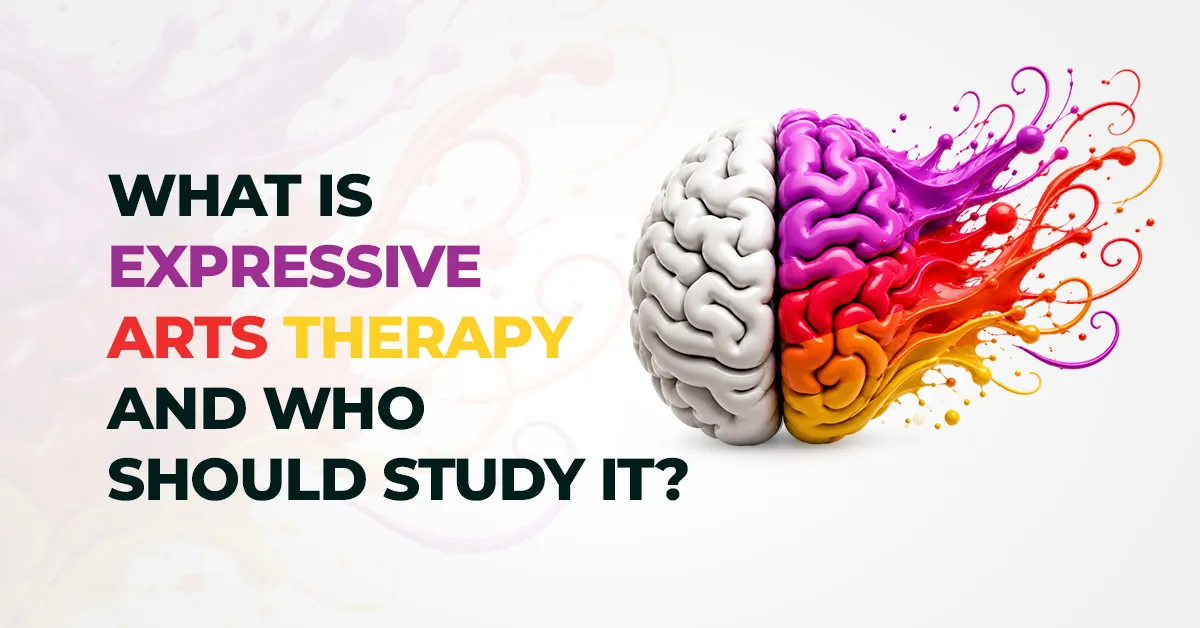
What is Expressive Arts Therapy and Who Should Study It?
Therapy for Mental Health concerns is often perceived as sitting across from someone and talking. For centuries as the field of Psychotherapy has evolved, it has been seen to work for many upto a certain level. but not for everyone. Individuals with specific needs such as children who can’t yet name what they feel or adults who’ve experienced and carried trauma in their bodies for years along with people for whom words have simply run out verbal therapies such as the traditional talk therapy isn’t always enough.
This where expressive arts therapy comes in.
It’s one of the fastest-growing areas in mental healthcare, and in India. While it is still in its teething stage, people who train in it now are likely to build careers with very little competition. But before you consider the path, it is always a good idea to understand what it actually involves.
What Is Expressive Arts Therapy?
Expressive arts therapy uses creative modalities such as movement, dance, music, drama, visual art — as therapeutic interventions. The goal isn’t to produce good art but help people access, express, and work through unconscious emotional processes that are difficult to express through words.
Think of a child who has experienced abuse and shuts down the moment an adult asks what happened. Or an elderly patient recovering from a stroke who feels isolated and depressed. Or a young adult with anxiety so physical it lives in their chest and shoulders.
For each one of these people, movement or creative expression can unlock something that conversations alone cannot. That’s the core idea behind expressive arts therapy — where the body, movement and artistic expression become the medium for healing
How It Differs from Regular Therapy
Traditional talk therapy is largely verbal. You talk; your therapist actively listens to respond and help you process difficult emotions. Whereas Expressive arts therapy encourages the same therapeutic relationship but complements the process (or supplements) with creative intervention. The therapist is trained to observe, guide, and interpret what emerges through this creative process.
For instance, within the purview dance movement therapy, one of the core modalities within the spectrum of Expressive Therapies, —a therapist might work with a group of patients with depression, using structured rhythmic movement to help them alleviate feelings of loneliness and reconnect with their own bodies as well as others in their group. While it may look like a dance class, it’s not as Dance Movement Therapists are trained to use movement as a psychotherapeutic intervention.
Who Should Study Expressive Arts Therapy in India?
Anyone drawn to where creative arts and healthcare meet. The training is physically and emotionally demanding. So ask yourself honestly — do you really want this career?
In order to be able to study and enrol for courses in Expressive Therapies, you need to have a foundational background either in Arts, be it any form or a clinical background in any of the healthcare streams.
● People with an Arts Background Entering Healthcare
If you studied dance, music, drama, or visual arts and you’ve always felt pulled toward working with people in a deeper and meaningful way, then this field was practically made for you.
Programs such as the Master of Arts in Expressive Movement Therapy offered at Sancheti Healthcare Academy (SHA) in Pune are specifically designed for people with backgrounds in MA Music, MA Dance, or MA Drama who want to apply their creative training in a clinical context.
Your arts training isn’t a detour — it’s your foundation.
● Psychology and Social Work Graduates
If you already understand human behaviour, trauma, and therapeutic frameworks, adding expressive arts therapy to your skill set makes you a more versatile clinician. You’ll be able to reach clients who don’t respond to conventional approaches. That’s a real advantage, especially in India where mental health services are still evolving and expanding their purview.
● People Who Work with Children or Differently Abled Individuals
Teachers, special educators, occupational therapists, and child welfare workers often encounter situations where a child simply cannot communicate verbally what they’re going through. Expressive arts therapy gives you structured, evidence-backed tools to work with those children in a way that doesn’t require them to articulate what they can’t yet say.
● Anyone Who Wants to Start a Career in Creative Arts Therapy
If you’re early in your career and you want a path that sits at the intersection of creativity and healthcare — this is a good time to enter. India’s mental health sector is growing, awareness is increasing and trained creative arts therapists are still relatively rare. That gap won’t stay open forever.
What Does Training Actually Look Like?
An expressive arts therapy course in India at the postgraduate level will typically cover both theory and supervised clinical practice. At Sancheti Healthcare Academy, the MA in Expressive Movement Therapy is grounded in the theory and practice of dance movement therapy as defined by the American Dance Therapy Association — the idea that psychotherapuetic use of movement can promote emotional, social, cognitive, and physical integration in a person.
You won’t just learn about therapy in theory. You’ll practice it. You’ll observe experienced therapists working with real clients, and eventually you’ll work with clients yourself under supervision. That hands-on component is what separates a good program from a surface-level one.
SHA also offers a PG Certification in Dance Movement Therapy (DMT) for those who want a focused credential without committing to a full master’s degree.
Is This a Viable Career in India?
Yes — and more so than most people realise.
NCAHP, a national body that regulates allied healthcare professions has now recognised Expressive Therapies as an allied healthcare profession.
Those who successfully start a career in creative arts therapy in India work across hospitals, rehabilitation centres, NGOs, schools, psychiatric clinics, and private practice. Some work internationally.
The honest caveat: it takes time to build. This isn’t a field where you graduate and immediately have a full caseload. But neither is any other therapeutic profession. The difference is that creative arts therapists often find their niche faster, because the work is distinct enough that word spreads among the communities who need it.
Conclusion
What is expressive arts therapy, at its heart? It’s the belief that healing doesn’t only happen through words. It happens through movement, creativity, and connection — and that some people need those pathways more than others.
If that idea resonates with you, and if you’re the kind of person who can hold space for someone else’s pain without being swallowed by it, this field is worth taking seriously. An expressive arts therapy course in India — especially through a structured, clinically grounded institution like Sancheti Healthcare Academy — can give you the training to turn that instinct into a profession.
The people who need this work exist. The question is whether you’ll be ready to meet them.
Tags:allied health professions art therapy courses India child therapy techniques Creative Arts Therapy creative therapy training Dance Movement Therapy emotional healing therapy Expressive Arts Therapy expressive arts therapy course in India healthcare career options mental health therapy courses psychology careers psychotherapy courses rehabilitation therapy therapy certification India
Previous